Conference
How can the challenges of reducing technical debt and decarbonising IT converge? Insights from Schneider Electric


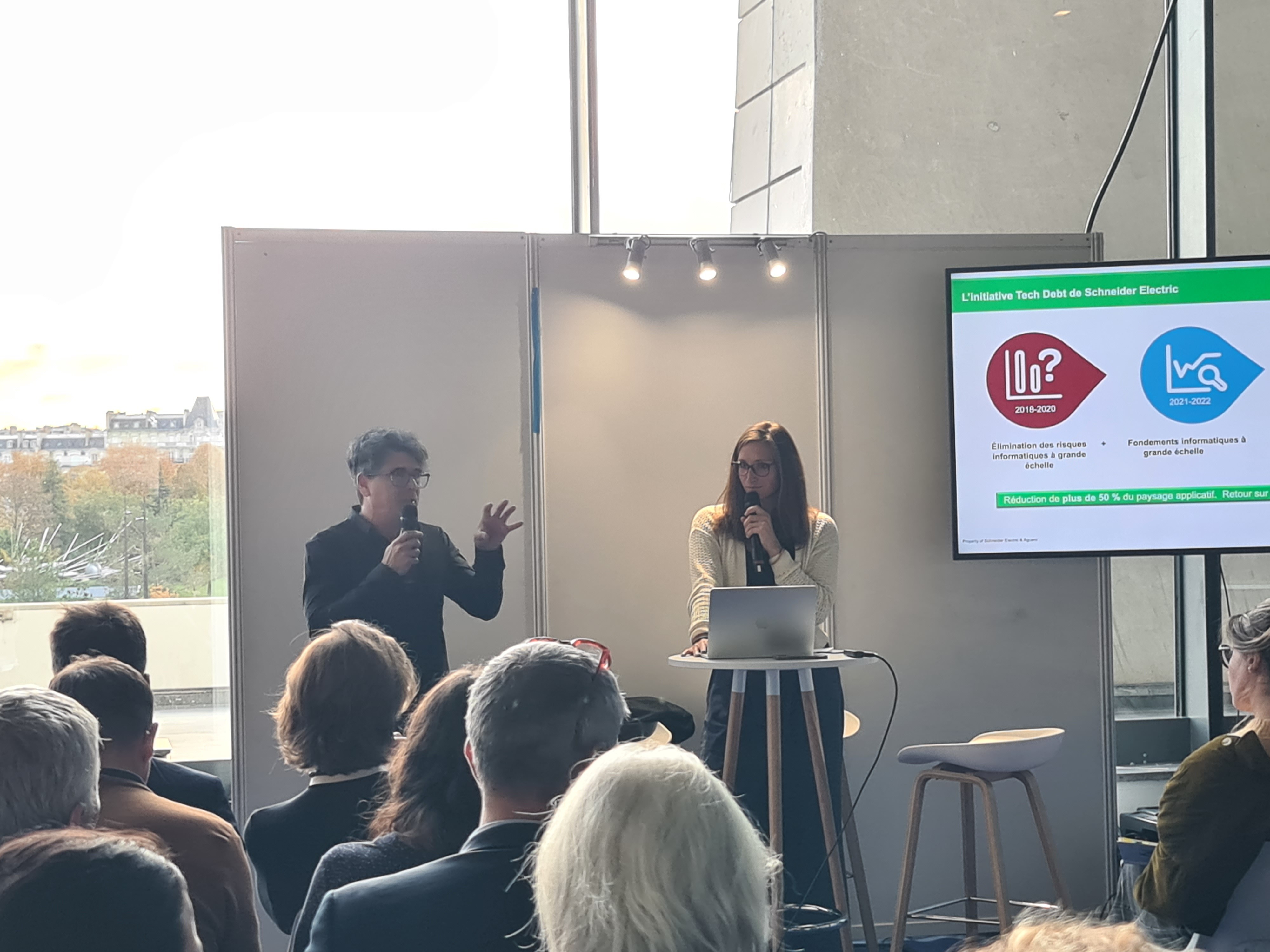
On 4 November at the GreenTech Forum – a key event for organisations working towards more sustainable, ethical and inclusive digital practices – Aguaro co-hosted with Hervé Guirado, Schneider Electric’s Vice President of Apps simplification & Technical Debt, a workshop entitled “Schneider Electric: Converging Tech Debt Reduction and IT Decarbonisation".
A global specialist in energy management and industrial automation with a presence in more than 100 countries, Schneider Electric has accumulated a large number of applications through years of mergers and acquisitions. As a result, in 2018, 70% of the application portfolio was identified as technical debt, with a significant risk of undermining the company's operational and commercial performance and a high carbon footprint.
In order to achieve the three objectives set by the company, namely to be:
more resilient
more efficient
more sustainable
Schneider Electric's IT department launched an initiative to drastically reduce this debt, simplify its application portfolio, eliminate the associated risks and standardise processes to avoid creating new debt.
By reducing technical debt and retiring obsolete or redundant systems - often the most carbon-intensive* within an IT landscape - Schneider Electric was able to modernize its stack, lower its environmental footprint, accelerate its digital transformation, and secure its objectives. Ultimately, a virtuous circle has been created.
Watch this replay to learn how Schneider Electric addressed these challenges using Aguaro’s native ServiceNow application, the smart capabilities of the solution - especially the allocation engine -, and the expertise of the Aguaro team on Sustainable Digital issues.
* Indicator defined by the SCI (Software Carbon Intensity) standard proposed by the Green Software Foundation, which measures the greenhouse gas emissions generated by software or an application, thereby enabling its environmental impact to be assessed and reduced.