Guest
Reducing the Environmental Impact of Paris 2024: Interview with Benjamin Lévêque


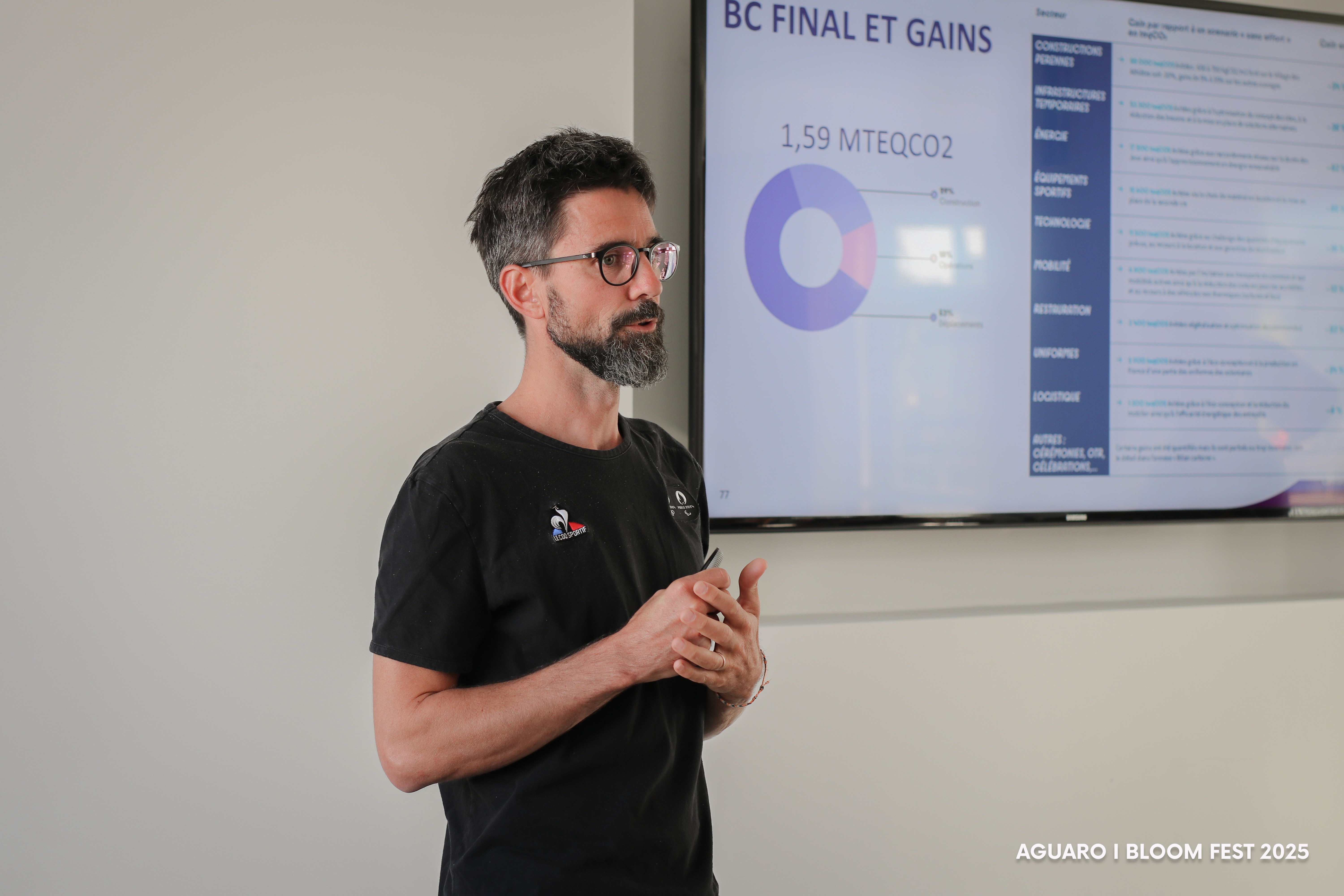
At the third edition of Bloom Fest, the Aguaro Users Club, we had the great pleasure of welcoming Benjamin Levêque, Climate and Biodiversity Manager for the Paris Olympic and Paralympic Games. He shared his career path with us as an expert in reducing environmental impact, particularly his experience of integrating environmental issues into major events.
What is your professional background and how did you get involved in the Olympic Games organisation?
I am an engineer from AgroParisTech*. After graduating, I worked in consulting and quickly chose to focus on the environment. I worked for a specialist company called I Care, where I helped public and private clients assess and reduce their environmental impact.
We developed a specialised service for stakeholders in the sports sector, working with several clubs and different stadiums to help them understand and, above all, reduce their environmental impact. One of the projects we won was to support the candidature of Paris for the 2024 Games, in 2016 and 2017. That's where we laid the foundations for the environmental performance of the Games.
Following this mission, I was recruited to the Organising Committee, which was formed in 2018 to implement the strategy that had been drawn up. I was recruited as Carbon Impact Manager, which was a new position for the Games. As I was keen not to focus solely on carbon, I also got involved in biodiversity issues; in the end, I was able to work on both climate and biodiversity... and I did that for five years.
You mentioned that there is a certain ‘novelty’ associated with your role?
Not everything was new in terms of the Games' consideration of the environment. London, in 2012, had laid some groundwork, particularly in quantitative terms: it was the first time that serious impact assessments had been carried out. Before that, Vancouver, in 2010, had conducted several interesting initiatives. Lillehammer had done so even earlier, with the development of renewable energy solutions that left an interesting legacy. So we are not the first, obviously and fortunately, to ask questions about the environment, but this is the first time that it has been so well anticipated and staffed, since we had a team that ultimately consisted of around twenty people, as well as numerous contacts within other departments, sites, partners, service providers, etc.
Who recruited you, Tony Estanguet?
It wasn't Tony Estanguet directly, it was Georgina Grenon, who is an energy specialist and was the director of environmental excellence. As for Tony, we worked with him extensively beforehand, including training him on carbon impact, biodiversity impact and the circular economy, because these were important topics for him, and we provided him with information to help him understand them better. And then his subject is water, shortages and pollution, which directly affect his sport. So that was something he knew well.
Let's get back to the preparations for the Games. How is this organised in practical terms?
It’s fairly standardised by the International Olympic Committee (IOC), which supports the various host cities and organising committees. It's managed in 3+4, so that's seven years of preparation for the Games. Three years before the previous Olympics – in this case, it was quite disrupted because Tokyo 2020 was postponed to 2021 –; there is a long planning and strategy phase.
Then we enter a more tactical phase over the four years, and there is a final year of ‘rush’, called ‘Operational Readiness’, where we have to work meticulously to plan what will happen during the two separate two-week periods. The Planning Department is a bit like the conductor of the orchestra, fed by the CIO; it will bring all the strategies to fruition at the right time. It's ‘Design-to-time’ and not ‘Design-to-cost’: everything is dictated by the date of the opening ceremony. As much as possible needs to be ready for the big day.
More specifically for the Environment team, it was a complex question of what we were going to do during the Games, since we had actually planned a great deal, including in our contracts with suppliers and partners. So we were in an unusual position for events that generally do much less before and after, trying to raise awareness and promote a few specific actions... We finally appointed a representative at each of our 40 sites – who were volunteers from different departments – to become the ‘environmental managers’ for each of our sites, which meant that we had a strong presence on the ground, which was interesting.
These people were in addition to the team: were they also trained?
Yes, they had several training sessions and then we equipped them with relatively simple checklists, covering all the operational issues you might expect to find at their competition site on a daily basis, such as water management, energy performance, waste, food, etc.
What were your three main challenges?
We were fortunate to be able to rely on a shared desire to anticipate and go the extra mile. However, we did face challenges in delivering and, more generally, in implementing changes that were sometimes significant for operational staff. Our challenges were to overcome three objections:
‘It's going to cost more.’
‘It will be too complicated to change, we won't have enough time.’
‘It will be too risky.’
There are a number of risks that can affect safety. We have the case of water bottles, for example, which we managed to get authorised, but it was a tough battle: it ended up being decided by the Prime Minister that spectators could bring reusable water bottles to each of the venues.
There may be less significant risks, not in terms of safety, but in terms of the comfort of certain spectators or certain ‘customers’ of the Games: not installing air conditioning for the athletes, for example, was a risk that was ‘absorbed’ as best we could.
So the challenges were potential constraints on the budget, technical complexity and perceived risks. Each time, the solution was to show – while remaining objective – that things could go in the right direction. On the economic side, we really worked hard to show that money could be made by doing better in terms of the environment and technical complexity. It’s the kind of time operational staff need to be willing to invest... when they are convinced that things need to be done differently.
For all temporary infrastructure, for example, we also held training sessions with all the architects to push for alternative solutions, generally elements that require fewer materials.
And what about the nature of these materials?
There was a broader circular-economy approach, resulting in an estimated circularity rate of 90% for the event, compared to an estimated global circularity rate** of 7%. Events are generally quite well off because they involve a lot of rentals and relatively few purchases, so that's a point that helps the sector. There is little creation of new materials; we are able to use existing stocks. So that was the first big job: avoiding production.
And then, once we avoided production, there was still a part that needed to be ‘assembled’; so there were specifications on the choice of materials, and these were criteria that we pushed in a responsible purchasing strategy, to move towards materials with less impact.
Life Cycle Assessments (LCAs) must have been carried out?
Yes, by suppliers and partners. We did not conduct an LCA for the Games as a whole. It was a question we asked ourselves several times: we tried a little during the bidding process, but there were too many complicated methodological issues to be able to do it for the Games as a whole. However, for certain products, some suppliers provided us with LCAs to guide our choices.
And what about the overall carbon footprint? Were there any specific targets?
Yes, absolutely. The responsible purchasing strategy included five commitments, one of which was on carbon. So we asked our hundred or so partners to provide information on the impact of their products or services in their contracts. There were other clauses that required explaining, in percentage terms,gains linked to the proposed solutions versus no-effort benchmark scenarios. We were able to push this in the markets when there was an issue at stake, when there was associated carbon weight. It was pushed very hard on permanent infrastructures – particularly in the Village, where there was even a CO2 target per square metre for construction: this was the first time this had ever been done. We imposed reductions of 35% to 40%, which were achieved.
A 35% reduction in carbon footprint per square metre compared to previous Olympic Games?
No, compared to conventional construction in France, to the production of buildings in France in 2020. And so this figure pushed all the developers to rack their brains in the early stages, and that's what led, for example, to much more construction using wood – i.e. the structures and facades of the Village – with 15,000 m³ of wood used in the end, thanks to these early specifications.
How did you manage your carbon emissions?
We worked with a solution called Toovalu [editor's note: Aguaro's partner and co-author of the summary note on the impact of AI], which adjusted its tool - based on a standard annual carbon footprint assessment - to model our emissions. They built a model that allowed us to see where we stood in terms of emissions consumed and emissions allocated – for which we no longer have any leeway – which we were able to monitor with the finance department. It wasn't perfect because, as in all operational departments, there are sometimes significant uncertainties about many factors until the event takes place, but it gave us an idea of the impact and that helped us a lot.
What could a solution like Aguaro have offered you?
We monitored the environmental impact of the Games for almost 10 years: before, during and after the event. A tool such as Aguaro, connected to internal information management systems (purchasing, travel, ticket tracking, etc.), could have enabled us to obtain an even more accurate assessment of our emissions and identify other potential avenues for reduction. Project management features at the operational level would undoubtedly have facilitated the implementation and promotion of frugal practices.
Have you experienced any setbacks that you could share with us, and how did you overcome them?
We could have been more ambitious with the air conditioning, for example. Although we didn't have any in the Village, some delegations did bring in temporary air conditioning units. So we didn't do a good enough job of explaining that the building's thermal performance would be sufficient.
Another example is combustion engine vehicles: we weren't able to use 100% electricity for the torch relay, as this would have added too many constraints for the operational staff.
Another area where we may not have gone far enough is textiles. We could have sourced more locally and organically, but that would have required more money; this is an area where the environment and the economy are not aligned. So we were unable to find the budget to do better, and we may not have pushed hard enough to change the model in this sector.
And on success: you've already mentioned some positive achievements, but is there anything that really stands out for you?
Well, there's the legacy: what stands out is the Seine, which is now suitable for swimming, with 100,000 people taking a dip this summer, and then the quality of the 2,700 homes in Seine-Saint-Denis; so that's something that will remain for a very long time.
Then there is the change in the model for the Games, i.e. the fact that, from the outset of the bid in 2015, we wanted to rely 95% on existing and temporary facilities and not build anything new. The only new sports facility built was the Olympic Aquatic Centre (CAO).
We hope that this model will inspire our successors. This is already somewhat the case, so that is also a success.
Also, the fact that we have – this is a little more technical – integrated the issue of the environment into all areas of our work. We really worked with buyers, with specialists in energy, technology, catering and transport. We tried to avoid Sustainability being treated as an annex, so the fact that the subject was a little ‘thing’ on the side, we really wanted it not to be an annex to the specifications but to be in the very content of the specifications.
And the last point, in terms of methodology – what we did with carbon is quite emblematic of this – is the fact that we were able to anticipate, integrate and manage carbon emissions rather than waiting until the end of the event to assess the situation.
One year on, what is the environmental impact of the Games?
We have achieved our goal, as we had pushed to halve [the carbon footprint, editor's note] compared to the London and Rio Games, and we have done a little better than that, with very good results in terms of construction thanks to our friends at SOLIDEO*** – the Village and the CAO in particular – and very good results – even beyond what we had hoped for – on operations. On the other hand, the results were lower in the area over which we had the least control, namely spectator emissions: this depended largely on the split in spectator origins, and there were more Americans than expected, which significantly increased emissions. We gained on construction and operations, and lost on spectators.
But we are on track to halve our emissions, which is fantastic.
Biodiversity is a subject that cannot be summed up in a single indicator, but we had very few incidents and implemented around 750 measures at each of the 40 sites to prevent and reduce impacts. Our report contains a detailed assessment explaining what we have put in place, including kilometres of protected areas, which may be wetlands, for example, or wooded areas in Elancourt, etc.
In terms of the circular economy, we have achieved 90% circularity.
So that's it for the three main environmental stakes; and then there's the legacy – which is partly an ecological legacy : the Seine is now swimmable, with 75% less bacteriological pollution, and the Village, with its apartments currently being sold, is set to become an eco-neighbourhood.
And what does the future hold for major sporting events?
It's funny because L'Equipe has recently published a short article on the Games in 2124. It's a bit of a classic take on technology, with data everywhere, sensors on athletes that everyone can access, different sports – drone piloting, sports on the Moon... – it's really science fiction, it's a long way off, 100 years.
But in the shorter term, there's the question of technology and ecology, and we need to push for both to be taken into account, so that technological progress doesn’t overshadow ecological priorities.
I think there are two points: the first is, in the shorter term, that it must be adapted to climatic conditions, so obviously heat and humidity, but also extreme events. And if possible, do a little more than just adapt, but push for adaptation in the host cities through sports infrastructure or through changes in the city, greening, shading.
So that's the first point, and the other is about impact issues, pushing to do better – which we have done – so thinking about carbon, biodiversity, resources, pushing for the ‘positive’, in other words, managing to use no materials at all – which is far from being the case for us, with 130,000 tonnes of materials having been “used up” by the Games –; managing to produce energy, for example, and in terms of biodiversity, managing to regenerate, in other words going beyond the footprint.
This dictates sports that will not be the same as today, which will be more sober sports, without equipment, without ancillary energy consumption.
And also to do better on carbon, less travel – which remains the bulk of the impact.
And in terms of managing environmental objectives, do you think there are things that can be done?
We need to keep looking ahead and set impact limits, and then do better than we are doing in terms of day-to-day management and decision-making support, informing each decision beyond economic issues with carbon impacts and environmental indicators.
* French public institution that provides training for engineers, executives and doctors in the field of life sciences and environment
** also known as "circular material use rate" (CMUR) , i.e. the share of reused or recycled in the overall production cycle
*** Olympic Delivery Authority