Press review


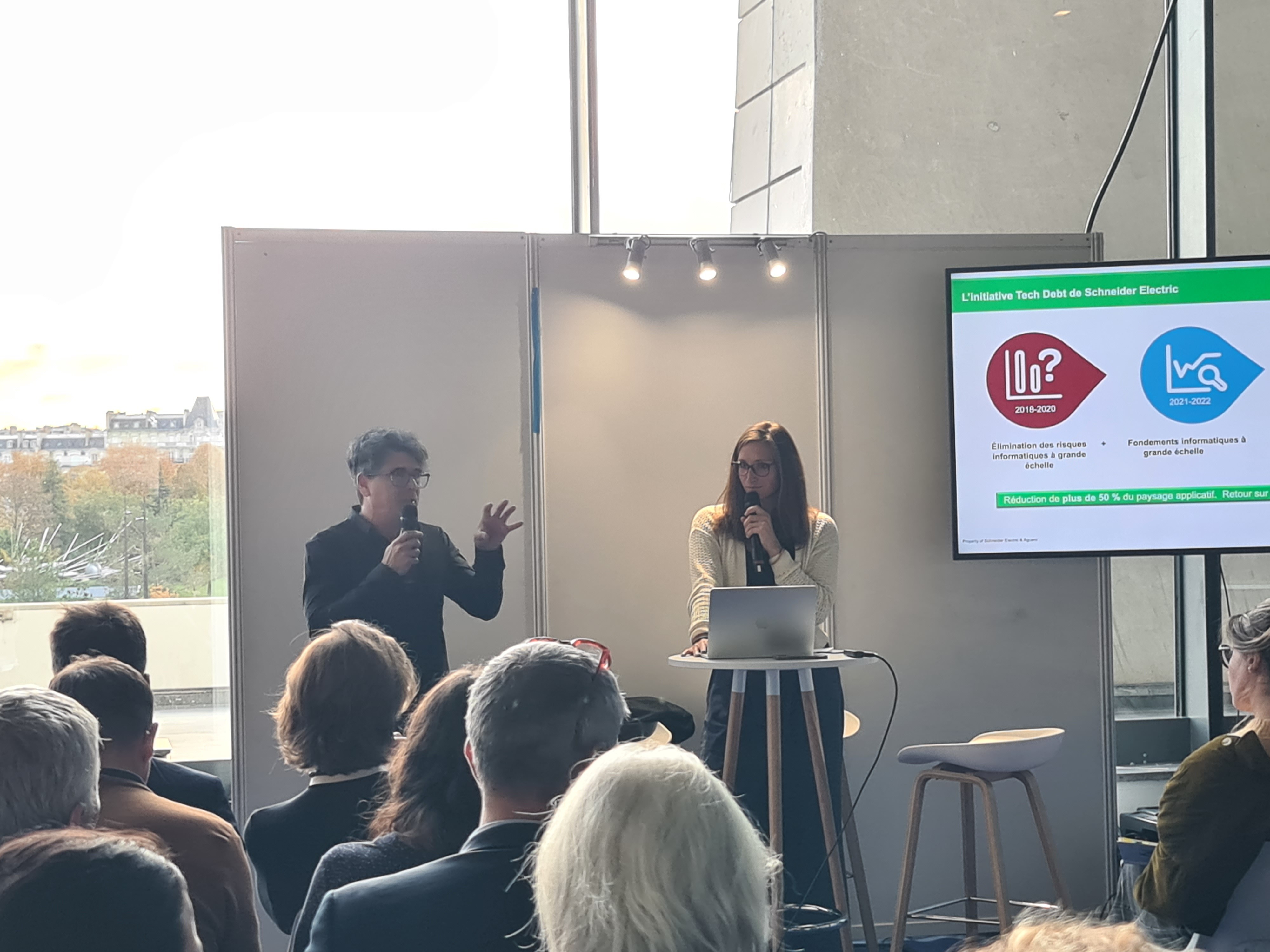
Press review - Hervé Guirado, Vice President of Apps Simplification & Technical Debt at Schneider Electric, with whom we co-hosted a conference on the convergence between technical debt and decarbonisation of information systems at the latest Green Tech Forum, recently shared his insights with Fabrice Deblock, Tech & Digital Sobriety Editor at the leading French IT magazine Alliancy.fr.
Tech debt reduction strategy, environmental and financial cost reduction targets, selection of Aguaro's ServiceNow add-on to manage the environmental footprint of the application portfolio, make data-driven decisions and prioritise action plans: find out about all the challenges and actions undertaken by Hervé in the interview translated below (find the original interview here).
Schneider Electric combines technical debt reduction with IT decarbonisation
At Schneider Electric, reducing technical debt is part of a long-term strategy to transform the IT system. Given the legacy application landscape resulting from multiple acquisitions, the group has set up a global simplification programme, which has now been extended to measuring and managing the environmental footprint of IT thanks to the software publisher Aguaro.
Within the Schneider Electric group, reducing technical debt is part of an IT transformation strategy that has been underway for five years. Due to numerous acquisitions, the group's application landscape has become increasingly fragmented, making the IT system more costly, complex and risky to manage. In response, Schneider Electric has structured a global simplification programme, now extended to include the measurement and management of the environmental impact of the information system.
This project is based on a methodical approach, carried out in three stages. "Technical debt represents everything that creates friction in the ability to deliver business value," summarises Hervé Guirado, Vice President of Apps Simplification & Technical Debt at Schneider Electric. Stage One involved eliminating applications that posed major risks, particularly in terms of cybersecurity, continuity and agility. Stage Two aimed to reduce functional overlaps by converging towards a core set of applications for each business unit. Stage Three focuses on streamlining processes through group-wide digital transformations, to accelerate the simplification of the IT system in a sustainable way.
This process has already delivered significant results. The number of applications has been halved, from 6,000 to 3,000. However, benchmarks show that a target of around 1,000 applications remains achievable, as long as process standardisation and transformation roll-out across sites continue.
Extending IT simplification to environmental issues
Once the simplification process is underway, the question of its environmental impact gradually arises. As Green IT methods mature and the group's Net Zero objectives take shape, Schneider Electric is integrating this dimension into its IT roadmap.
"Complexity automatically translates into environmental debt, with energy consumption and impacts that no longer have any operational justification."
While the environmental footprint of IT is already monitored at a global level, this vision is not enough to drive action. "It does not allow us to understand the causes of variations or to prioritise concrete actions," he points out. The group is therefore seeking to drill down to a more granular level, by application and associated infrastructure, using governed data that can be exploited on a global scale. The challenge is to link technical debt, costs, risks and environmental impact within a single management framework, without expecting perfect accuracy from the outset.
Aguaro: native integration with ServiceNow
To support this evolution, Hervé Guirado's teams are looking for a solution that can be integrated into the existing architecture. They have chosen Aguaro, a publisher of a SaaS solution dedicated to measuring and steering the environmental footprint of information systems. The decisive factor was its native integration with ServiceNow, Schneider Electric's core IT management platform, covering the application portfolio, CMDB and IT services.
This approach avoids the creation of a parallel data repository and limits the risk of generating new technical debt. "Aguaro adds a layer of intelligence and computation on top of existing data, without imposing its own data model," explains Hervé Guirado. Compliance with recognised standards for measuring software footprint, results obtained during pilot projects and scalability of the solution also played a role in the decision.
Green IT indicators integrated into operational management
One of the main benefits of this integration is the ability to establish an initial usable carbon baseline per application, directly integrated into existing technical debt management dashboards. This visibility makes the issues concrete for IT owners, domain managers and project teams, facilitating ownership of the subject and decision-making.
"Aguaro also makes it possible to fill in missing data with consistent estimates, while acknowledging their limitations, so that no areas are left uncovered," emphasises Hervé Guirado. By leveraging the organisation already in place to simplify its IT systems, Schneider Electric is accelerating the transition from a measurement phase to an action phase through eco-design, GreenOps and more informed decisions on the application lifecycle.
This case illustrates a pragmatic approach to convergence between technical debt and IT decarbonisation. Rather than treating its environmental footprint as an isolated project, Schneider Electric has incorporated it into an existing process of simplification, standardisation and economic management of its information system.
"Technical debt and environmental footprint are two sides of the same coin. Reducing the complexity of the information system means reducing risks, improving business agility and limiting unnecessary consumption. Once the impact becomes visible and measurable, it becomes possible to take structured action"
concludes Hervé Guirado.
Thanks to Hervé Guirado for his enthusiasm and trust, and to Fabrice Deblock for this thrilling talk!